Microsoft Launches Decision-1 Scoring Model
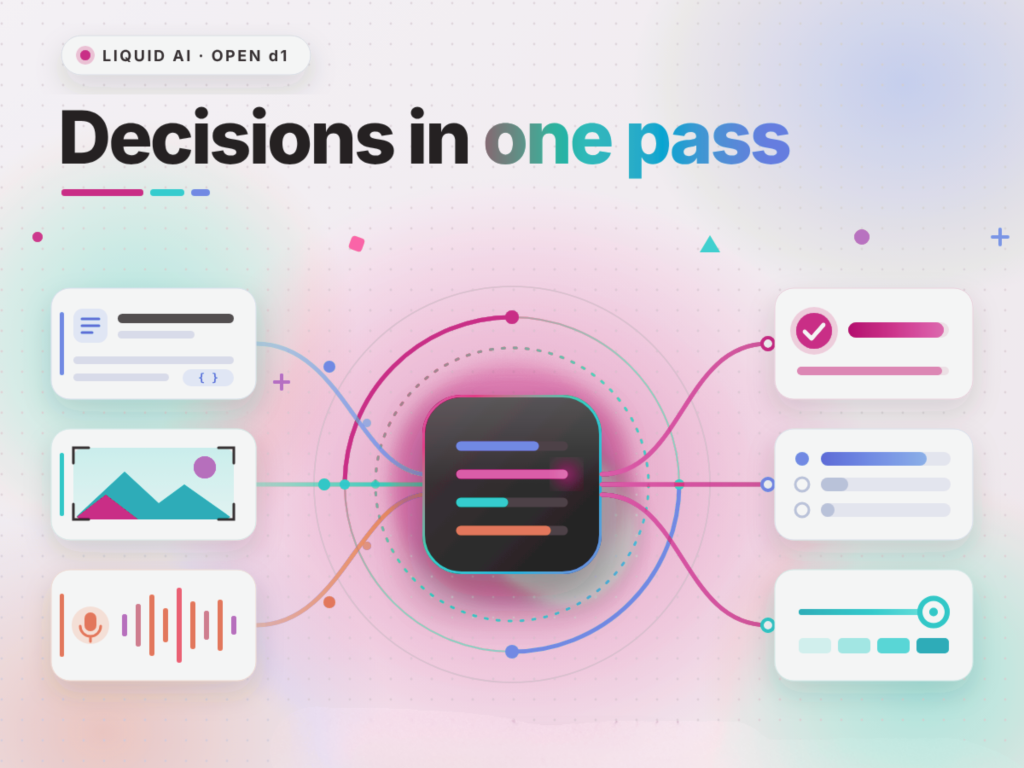
Microsoft has launched Microsoft-Decision-1, a specialized decision-scoring model designed to drastically speed up AI classification, routing, and verification tasks at low cost.
Microsoft has introduced Microsoft-Decision-1, a lightweight AI model tailored specifically for evaluating predefined choices like request routing, ticket classification, and agent output verification. Built by post-training Qwen3.5-9B, the system avoids open-ended text generation, tool loops, and multi-step reasoning traces to deliver single-pass probability scores across fixed choices. Available through Microsoft Foundry with planned OpenRouter availability, the service costs $0.042 per million input tokens, while output tokens are free.
To evaluate its capabilities, Microsoft tested Decision-1 against 36 benchmarks containing nearly 150,000 questions excluded from training data. At P50 latency, the model recorded speeds 35x faster than GPT-6 Sol and 4.5x faster than Quyet-1.0-Large. The specialized design also demonstrates high stability, flipping decisions on just 1.3% of input perturbations involving paraphrases, reorderings, and formatting noise.
In real-world internal workloads, Microsoft reported significant efficiency gains. While sorting over 10,000 survey responses and reviews from Steam and Xbox into predefined themes, the system operated 14 times faster and 200 times cheaper than GPT-6 Sol. For grading agent responses, it delivered competitive quality to GPT5.6 Luna at 100 times the speed, and in agent replanning tests, it showed 46 times more consistent scoring at three times the speed, accelerating adaptive replanning nearly fourfold.
For software developers and AI practitioners, this specialized architecture changes how complex agent pipelines are built. Instead of routing every step through expensive, high-latency frontier models, engineers can offload repetitive classification, safety filtering, and verification steps to Decision-1. Microsoft plans to launch future iterations built on its MAI models and OpenAI models, offering teams a consistent scoring API while retaining the option to swap out underlying backbones.
This is our own summary of reporting by AlphaSignal