Humanoid Robots Top Human Sprint Records at Beijing Games
At the second World Humanoid Robot Games in Beijing, sprinting robots surpassed human world records but also suffered fiery crashes, highlighting both rapid hardware progress and control limits.
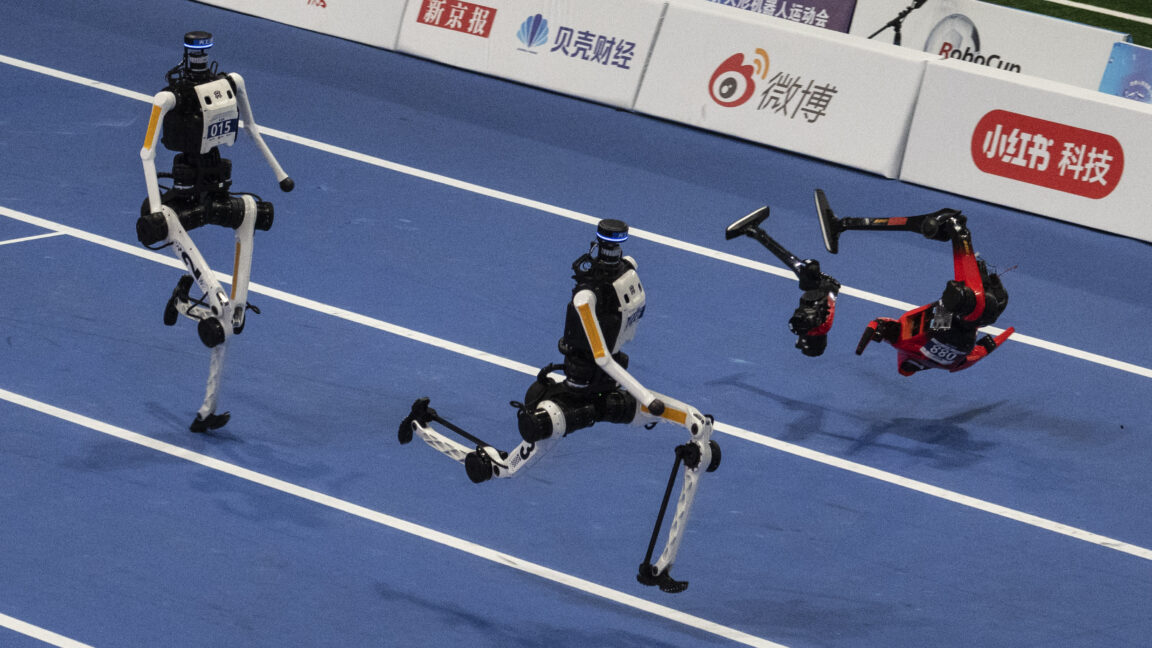
The second annual World Humanoid Robot Games, held in Beijing from August 22 to 26, showcased dramatic leaps in robotic capabilities alongside stark physical limitations. Humanoid machines surpassed human world records in the 100-meter sprint and the standing high jump. However, the high-speed runs often ended in disaster, with robots crashing into barriers or catching fire because they could not slow down. One competitor from Beijing-based X-Humanoid won a 400-meter race using an unusual posture with its arms held near its face, a technique learned through reinforcement learning in simulation.
Beyond athletics, the event tested robots in practical scenarios, though they lagged behind human speeds. At the Beijing Continental Grand Hotel, robots moved luggage, cleaned beds, and restocked supplies. A library shelving task tested visual reasoning, while an outdoor firefighting challenge required robots to identify hazards, close three valves, and extinguish a fire within 30 minutes. Only three out of 12 teams completed this rescue event. Additionally, six dexterity tests challenged the machines to pick up beans, drive screws, and hammer nails.
For robotics practitioners, the games highlighted the gap between autonomous operation and human control. Many competitors relied on human teleoperation, which incurred scoring penalties. The autonomous units did not process AI models locally, instead using 5G modules to offload computing to cloud-based embodied-intelligence systems. This reliance on remote processing and human intervention underscores that general-purpose autonomy remains unsolved. Gathering the massive visual training data required for robots to generalize across millions of real-world edge cases remains a major bottleneck.
Despite these hurdles, capital is flooding the sector, with investors pouring more than $6 billion into humanoid robotics in 2025 alone. While Chinese firms aggressively test their hardware, U.S. competitors like Boston Dynamics and Agility Robotics are deploying machines in warehouses, even as the U.S. government bans imports of Chinese-made robots. For developers, the event proves that while specialized whole-body control has advanced, building reliable, multi-tasking robots that can safely navigate unpredictable environments remains the industry's primary challenge.
This is our own summary of reporting by Ars Technica AI