Netflix deploys Claude to automate observability graphs
Netflix engineers Prasanna Vijayanathan and Renzo Sanchez-Silva revealed an ontology-driven observability system that leverages Anthropic's Claude to turn massive telemetry flows into actionable knowledge graphs.
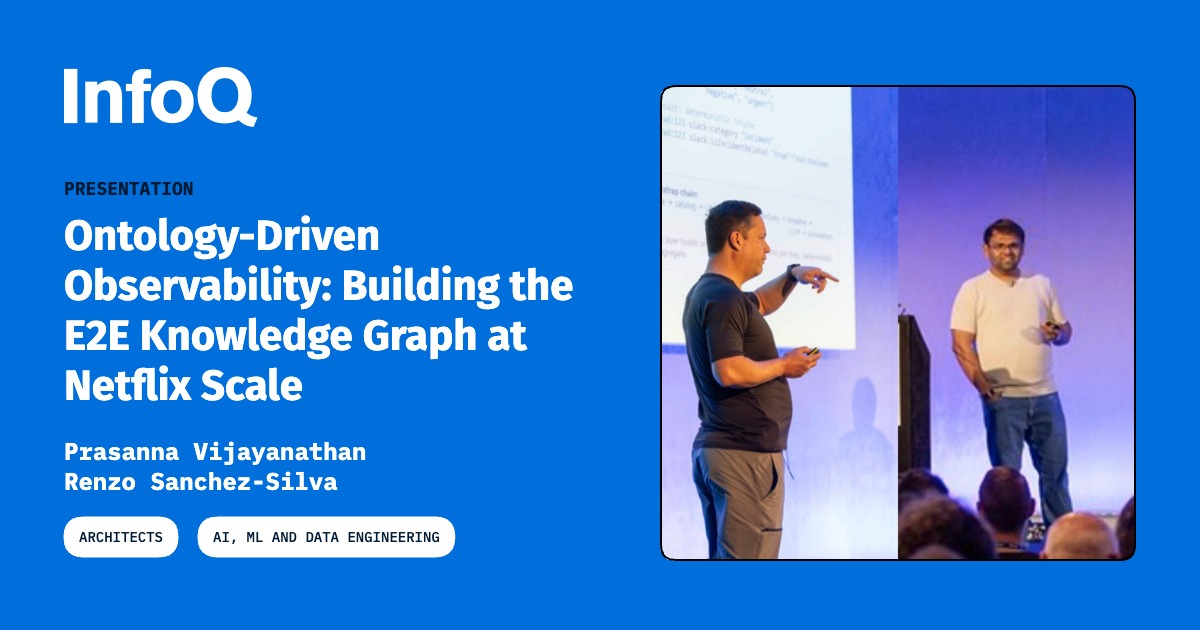
Netflix has deployed an ontology-driven operational knowledge graph to replace traditional reactive monitoring across its global engineering ecosystem. Operating at a scale handling over 2 billion daily application requests and managing peaks of 65 million concurrent streams—recorded during its late 2024 live boxing event—the platform processes upwards of 38 million real-time logging events every second. Prior to this implementation, correlating user-facing disruptions across thousands of microservices required navigating isolated telemetry silos, where a standard incident typically paged 9 separate teams and engaged over 30 engineers across a 4-hour root-cause investigation.
To unify this telemetry, Netflix engineers Prasanna Vijayanathan and Renzo Sanchez-Silva constructed an operational ontology using W3C standards including RDF, OWL, SHACL, and SPARQL. The underlying architecture consolidates metrics, events, logs, and traces into subject-predicate-object semantic triples stored in QuipuDB, a dedicated graph database. During active incidents, a specialized harvest pipeline processes unstructured Slack conversations and PagerDuty alerts through deterministic regex enrichers and Claude LLMs. Operating within isolated Git worktrees, Claude dynamically extracts new entity relationships, executes automated self-healing scripts, and autonomously upgrades its own underlying model from Claude Sonnet 4.5 to 4.6 during execution loops.
For SRE and infrastructure practitioners, this approach demonstrates how combining probabilistic generative AI with strict symbolic ontologies solves the diagnostic limits of distributed tracing. By restricting LLM outputs to predefined schema taxonomies, practitioners obtain deterministic, queryable knowledge graphs rather than unreliable AI assertions, enabling automated triaging and predictive self-healing across complex cloud infrastructures.
This is our own summary of reporting by InfoQ AI