DeepMind Outlines Limits of AlphaFold 2
AI leaders from Google DeepMind and Biohub warned that protein structure prediction remains incomplete five years after AlphaFold 2, urging a shift toward dynamic cellular modeling.
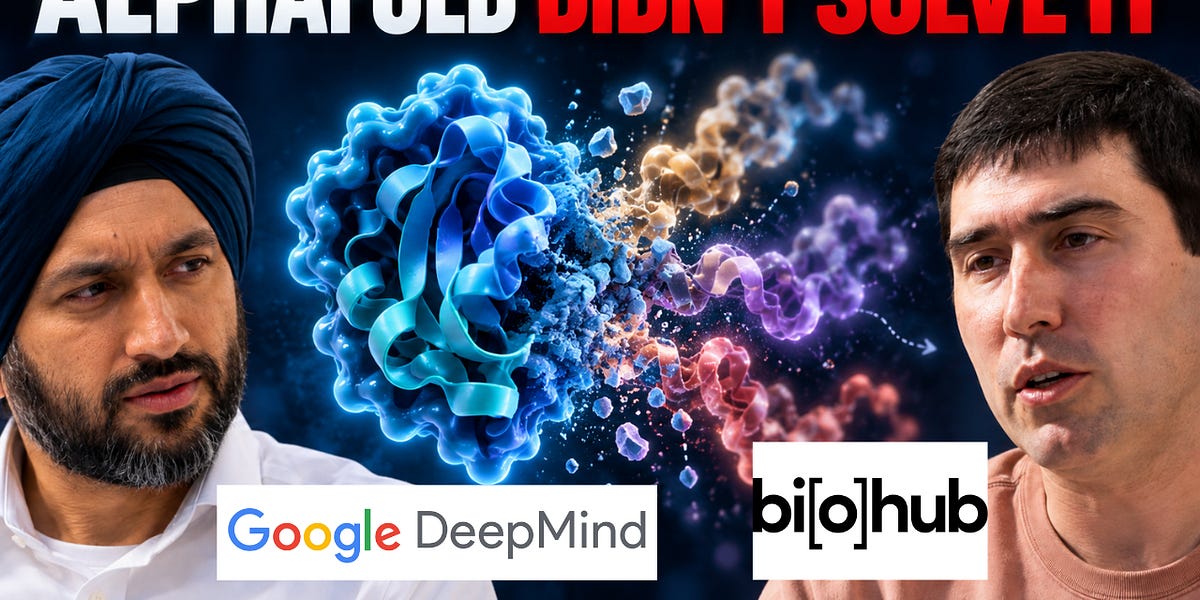
During a panel discussion on biological AI, Google DeepMind research director Pushmeet Kohli and Biohub engineer Sal Candido emphasized that AlphaFold 2 did not completely solve the protein folding challenge. While AlphaFold 2 achieved an unprecedented global distance test score of about 90 on benchmark sets—a threshold that could theoretically reach a GDT score of 95—the system primarily models static protein conformations from the Protein Data Bank rather than dynamic, disordered biological states. Five years after the breakthrough was announced, researchers are confronting the reality that scaling up compute or internet-scale data alone will not yield complete biological understanding.
Addressing data strategies, Candido noted that training protein language models on low-quality metagenomic sequences can surprisingly improve overall performance when designing functional proteins. However, both experts agreed that progress requires tailored architectural biases rather than relying solely on generic transformer models. Kohli highlighted cryo-EM micrographs as a vital, underutilized raw data source capable of revealing structural distributions and dynamics that static models miss. Bridging these gaps will require shifting from isolated protein predictions toward comprehensive virtual cell simulations.
For computational biologists and machine learning practitioners, the session underscored that model calibration matters more than complete human interpretability. Kohli emphasized that confidence metrics like the pLDDT score are essential because an uncalibrated model that predicts wrong answers confidently is practically unusable. Rather than striving for full transparency in deep architectures, scientists should focus on verifying behavioral reliability, uncertainty metrics, and moving beyond single-protein predictions to tackle complex biological interactions.
This is our own summary of reporting by Latent Space